Hello friend,
I hope 2026 brings you steady energy for your own projects, and art, books or music that feel like good company along the way. 🙂
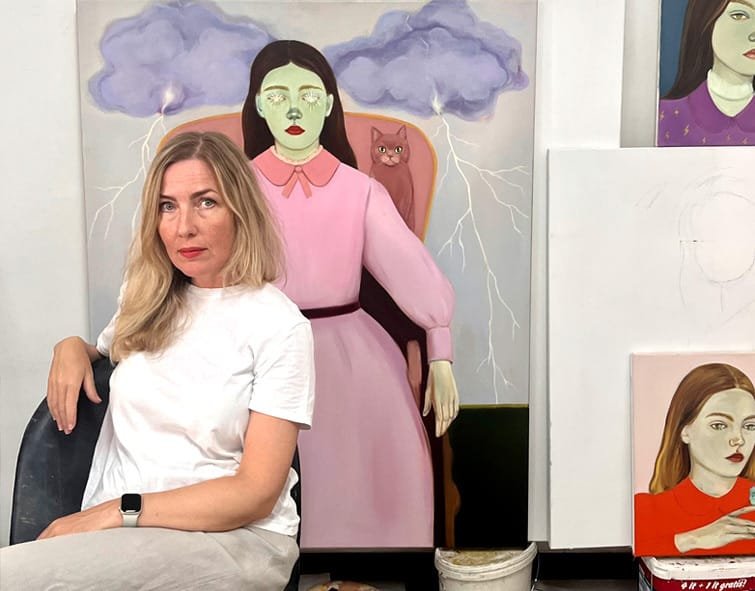
Today I really wanted to share something with you – a conversation with painter Camilla Mihkelsoo (b. 1978), an Estonian-born Finnish artist who now lives and works in Sicily, Italy.
Some of you might remember I mentioned her briefly in an earlier newsletter; this time you can get to know her work and world more closely.
In this conversation, Camilla talks about her path from Tallinn to Finland and Sicily, the quiet but insistent role of painting in her life, and the enigmatic figures, cats and double eyes that keep appearing in her work. I found it both tender and a little haunting – in a good way.
You can also read the interview on my blog here: Interview with Camilla
If it resonates with you, feel free to forward it to a friend who might enjoy it too. And don’t forget to check out her Instagram page to see more. ❤️
Warmly,
Helen
👇 The full interview is below:

Camilla Mihkelsoo (b. 1978) is an Estonian-born Finnish visual artist who lives and works in Sicily, Italy. She works primarily with figurative oil painting, often based on found photographs, film stills and her own image archive. Placing the human figure at the centre, Mihkelsoo explores a subtle, psychological ambivalence in her characters, who inhabit staged, often monochrome spaces and seem to hover between presence and absence.
Mihkelsoo graduated from the Free Art School in Helsinki and earned her Master of Fine Arts in Painting from the Academy of Fine Arts, University of the Arts Helsinki. Recent solo exhibitions include Claw Marks on the Moon at Galleria Halmetoja, Helsinki (2025), Cats, Tears and Cigarettes at V1 SALON, Copenhagen (2025) and Stargazer at Galleria Snow, Berlin (2022), alongside numerous solo and group exhibitions in Finland and abroad.
Her works are held in significant collections such as the Jenny and Antti Wihuri Foundation / Rovaniemi Art Museum, the Saastamoinen Foundation, Hämeenlinna Art Museum, the Finnish State Art Collection and others. In 2022, she was selected as the recipient of the Aïda Alliman Grant.
Camilla, you have a very interesting background. When someone asks you where you’re from—what your story is—what do you usually say?
I was born and raised in Estonia, in Tallinn. In the early 1990s, I moved to Finland with my parents. For the past twelve years or so, I’ve been living in Italy, in Sicily.
From a very young age, I’ve been interested in drawing and painting—art classes at school were always my favorites. I remember that we had art books at home that I leafed through with great fascination, and my mother took me to art clubs already when I was little. Deep down, I’ve always known that I wanted to become an artist, but making that a reality has been complicated. When I was younger, I heard from all sides, “for heaven’s sake, don’t choose being an artist as a profession.” So I tried other things, until in the end I found my way back to painting after all.
Coming to Finland from a place like a newly independent Estonia was an enormous change. People elsewhere in the world can hardly imagine it.
Moving to Finland really was a huge change—from a Soviet-era country to the Western world. Two completely different realities. And on top of that, moving as a teenager and leaving all your friends behind was incredibly, incredibly hard.
I had some idea of what Finland was like, and I already spoke the language before we moved, because we watched Finnish television at home. I wanted to understand what people were saying, and that’s how I taught myself the language. Through television, I also saw what the free West looked like, and of course it made me sad to think about why things were so different for us back home.
What perhaps surprised me the most was how I was treated at school in Finland. At that time, there were hardly any immigrants in Finland, and once people heard that I was from Estonia, I was automatically labeled as “Russian.” If I had been able to choose, I would have wanted to go back to Estonia.

VESTIDA DI VERDE, 2025. Camilla Mihkelsoo. Oil on canvas. 70 × 60 cm
How did you arrive at earning a master’s degree in art? You completed it relatively recently, in 2020. Presumably not by the usual route—high school, bachelor’s, master’s all in one straight line by your early twenties?
Yes, my art studies did take a different path than usual. I only began studying painting at the age of 32, at the Free Art School in Helsinki. After graduating, I worked as a freelance artist. I had a clear desire to pursue a master’s degree at the Academy of Fine Arts, but because I was living in Sicily, it took several years before I even applied.
To my surprise, I was accepted on the very first try. For the duration of my studies, I moved back to Finland.
What books are you reading and what music are you listening to these days—what other forms of inspiration do you “let pass through you” besides painting? In other words: what else has influenced the kind of person and artist you’ve become?
The music I listen to ranges really widely; it depends entirely on my mood. In the studio I usually listen only to certain artists: Lana Del Rey, Lorde, Billie Eilish, and so on.
At the moment I don’t have much time for books, because I have a little over one-year-old child who takes up most of my free time. The last thing I read was Jonas Hassen Khemiri’s Siskokset, and now I’d like to start Mariana Enriquez’s more recent book.
I think David Lynch has influenced me a lot ever since childhood. When Twin Peaks first appeared on TV, I was about twelve, and my parents let me watch it. I was so captivated by it… and at the same time, scared.

DOUBLE PEARLS, 2025. Camilla Mihkelsoo. Oil on canvas. 45 × 40 cm
To move to the art itself… If, for example, at an exhibition a visitor comes up to you and asks you to explain your art, what do you say?
The focus of my work lies in exploring the human condition, often mirroring my personal experiences and emotional states through female figures. My intention, however, is not to present autobiographical narratives, but rather to elevate each work to a more universal level of expression, allowing every artwork to embody its own reality.
The figures in my works often contain strange details and they seem to be lost in their own thoughts, somewhere in-betweenness, in ambiguous spaces. They look either directly at the viewer or past them — suspended in a state of melancholy, as if waiting for something to happen. This can evoke a sensation of ambiguity in a dreamlike state that is both haunting and familiar.
Cats are a recurring subject in my work. They can represent comfort and companionship but also something mystical- something that is tied to the night and the unseen.
I also have to ask about the eyes—the double pairs of eyes. Sometimes they appear on people, sometimes on cats, sometimes in the middle of the body. They leave a strong impression and create an intriguing effect. Almost as if they’re casting a spell on the viewer, or looking straight through them.
Eyes usually symbolically stand for noticing, understanding, awareness, wisdom and intuition – the ability to see the world that is hidden. I like to play with the idea of how much the figure in the painting sees or knows… perhaps it is the cat, after all, who sees what others are unable to see.

RIVEDERE, 2025. Camilla Mihkelsoo. Oil on canvas. 70 × 60 cm
Your color combinations are mesmerizing. Especially in recent years, they’ve become lighter, more fairy-tale-like—colors of dreaming and dreams. Is it the Italian sun shining through?
I’m asked that quite often. In fact, Italy has nothing to do with it. My color palette has always been the same. In that sense, moving to Italy didn’t change my world of color.
How much do you plan ahead which colours you will use and what and how you will depict things? Could you talk a bit about your process—how one of your paintings is born and comes to completion?
Before I begin what you might call the physical act of painting, there’s a preceding process where I go through my ideas and thoughts about what I want to realize, and I make sketches based on those. During the actual painting, that plan or initial idea moves into the background so that I can focus solely on painting. I choose colours in the moment—whichever ones draw me in and interest me. Sometimes it happens that it’s difficult to find the right colours… then you simply have to trust the process and keep trying until the right tones appear.
The fact that you have a good idea doesn’t mean it will always succeed. Everything can also change, so that the final result is something completely different. Painting has a will of its own—it’s a balance between control and freedom.
What do you think – does an artist need to know, before starting to paint, what they are going to express and what it means, and how their work fits into a broader context?
I think that, to some extent, you do need to know what you want to express when you paint. What it all means is perhaps more difficult to answer—it depends on how you approach the question. Painting as a medium is deeply connected to tradition—everything is built on what has been done and what has existed at a given time.
Finally – what is it that makes a person create art? What is that for you?
I would be very unhappy if I couldn’t paint. It’s almost as necessary to me as oxygen.

AFTERNOON NAP, 2025. Camilla Mihkelsoo. Oil on canvas. 60 × 70 cm
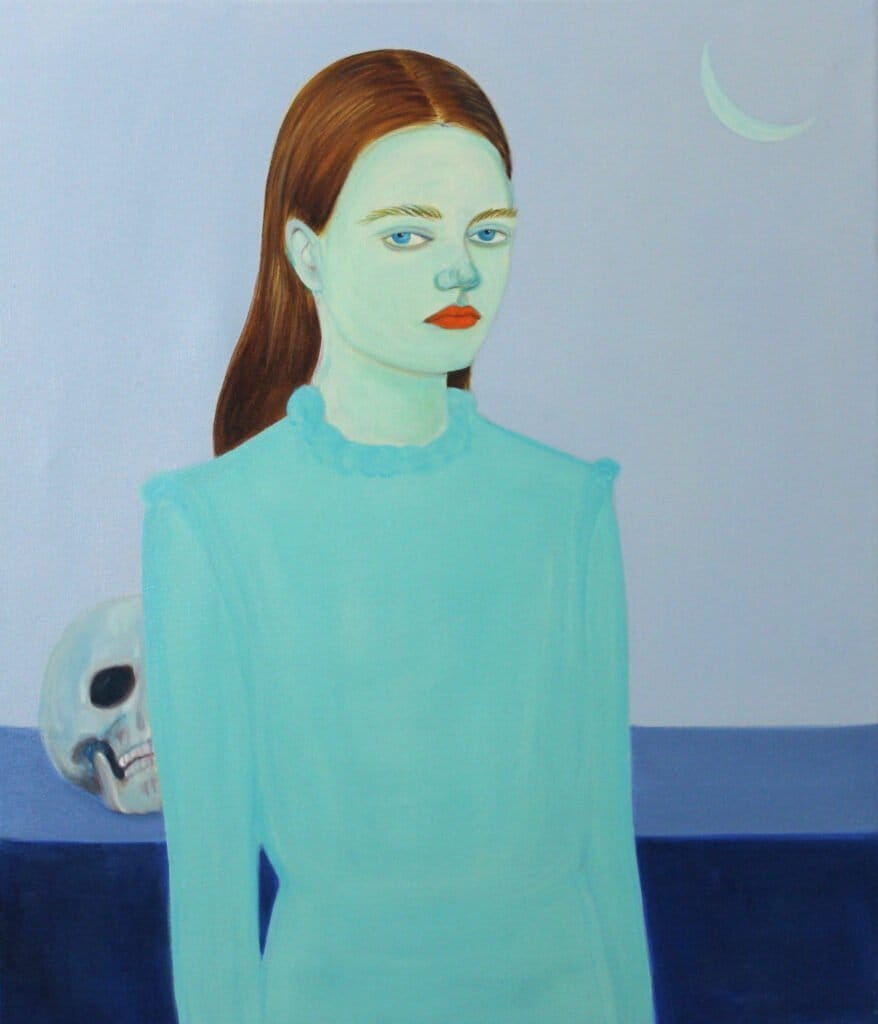
OLD FAMILIARS, 2025. Camilla Mihkelsoo. Oil on canvas. 70 × 60 cm
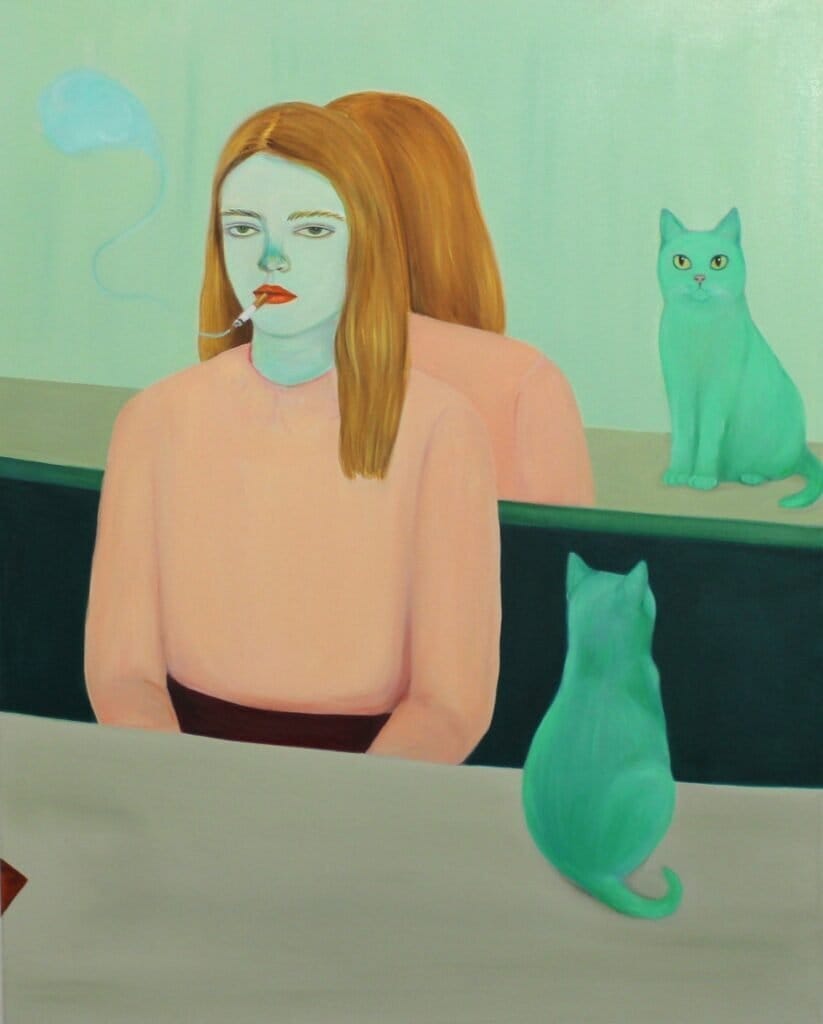
THINGS TO COME, 2025. Camilla Mihkelsoo. Oil on canvas. 92 x 73 cm

BOW, 2025. Camilla Mihkelsoo. Oil on canvas. 45 × 40 cm